The assassination of President John F. Kennedy on November 22, 1963, involved the main suspect, Lee Harvey Oswald. While many citizens disagree, the Warren Commission’s official answer is that the only shooter was Lee Harvey Oswald. Conspiracy theories such as the influence of organized crime, the involvement of the Central Intelligence Agency (CIA), and an additional shooter. While many of the theories were neither confirmed nor denied, each reflects a public mistrust of government institutions during and after the Cold War.
A main theory is that the Central Intelligence Agency staged the assassination in response to President Kennedy’s failure to accept the foreign policy with the Soviet Union and Cuba. Oswald’s ambiguous background: a former U.S. Marine who joined the USSR in 1959, lived in Minsk for over two years, then returned to the United States in 1962 (Mailer 154). Norman Mailer, in his biographical study of Oswald, draws on declassified files and FBI transcripts to argue that Oswald’s movements attracted the sustained attention of intelligence agencies, suggesting he was more than an ordinary private citizen (Mailer 74–78). Mailer’s theory highlights Oswald’s ties to the USSR and previous military connections, yet there is no evidence linking these contacts to CIA leadership. The significance of this theory due to the mistrust of the security state during the Cold War, suggesting that the President was not killed by a random citizen but by a government agency acting in its own interests.
Lee Harvey Oswald, a 24-year-old former military service member, is widely recognized for assassinating President John F. Kennedy on November 22, 1963. Born in 1939, Oswald experienced a difficult upbringing characterized by instability and psychological distress, which contributed to his withdrawn, attention-seeking, and reckless behavior. This analysis examines how Oswald’s early traumatic experiences influenced his eventual apostate to the United States. During Oswald's childhood, he showed social withdrawal from his peers. This behavior can be traced to his birth in 1939, following his father's departure and frequent relocations by his mother. Psychologists have observed that the lack of emotional care in Oswald's early years hindered his ability to socialize as an adult (Bugliosi, 4-7). His early isolation fostered increasing estrangement from society and contributed to his later radicalized actions. Alongside lack of support, Oswald had the need to be seen which became a driving force behind his actions, coming low self-worth and lack of emotional care during his childhood years. Unable to keep a job, Oswald’s stability started to diminish (Lee Harvey Oswald, 2026). The evidence describes Oswald’s search for validation as linked to his sense of isolation and a fragmented self-identity. Additionally, suggesting that the assassination stood for not a political act, but a desperate attempt to secure a legacy (Abrahamsen, 1967; Posner, 2003).
Lee Harvey Oswald and The Assassination of JFK

Section 2
Oswald’s actions of recklessness further damage his personal relationships in his life. Specifically, his documented abuse in marriage to Marina Oswald, which, according to Mailer (1995), proves a pattern instability and difficulty forming healthy attachments, is a part of his struggles. In addition, his frequent job losses and recurring interpersonal conflicts, described in detail by biographical accounts ("Lee Harvey Oswald" 2026), show efforts and repeated failures to keep relationships outside his marriage. (Abrahamsen, 1967) Viewing these patterns together, it's clear that these behaviors reflect what Abrahamsen (1967) characterizes as deep-seated feelings of inadequacy, isolation, and a instability characterisitc. Incorporating abuse in his marriage, show the extent to which his external conflicts were a direct result of internal psychological distress. (Abrahamsen, 1967) Lee Harvey Oswald exemplifies how an unstable childhood, evolving beliefs, and an intense need for recognition can coalesce to drive an individual toward extreme actions. While the complete reality of the assassination contest, a deeper analysis of Oswald’s psychological makeup reveals the mechanisms by which chronic isolation and unmet emotional needs contributed to his decision-making. This case highlights not only the personal repercussions of unresolved psychological conflict but also the wider societal implications when such issues go unaddressed. Therefore, Oswald's life underscores the importance of understanding individual psychological factors within broader historical events, suggesting that comprehensive attention to mental health could be critical in preventing similarly catastrophic outcomes.
The Theories
Abrahamsen, David. “A Study of Lee Harvey Oswald: Psychological Capability of Murder.” Bulletin of the New York Academy of Medicine, vol. 43, no. 10, Oct. 1967, pp. 861–888. PubMed Central, https://pmc.ncbi.nlm.nih.gov/articles/PMC1806829/.
Bugliosi, Vincent. Reclaiming History: The Assassination of President John F. Kennedy. W. W. Norton, 2007.
“John F. Kennedy’s Assassination: Photo Showing Lee Harvey Oswald with Gun Used to Kill Former President ‘Authentic.’” The Independent, https://www.independent.co.uk/news/world/americas/john-f-kennedy-s-assassination-photo-showing-lee-harvey-oswald-with-gun-used-to-kill-former-president-authentic-a6699751.html.
“Lee Harvey Oswald.” Encyclopedia Britannica, 2026.
Mailer, Norman. Oswald’s Tale: An American Mystery. Random House, 1995.
“Oswald in the USSR.” The New Yorker, 10 Apr. 1995, https://www.newyorker.com/magazine/1995/04/10/oswald-in-the-ussr.
Posner, Gerald. Case Closed: Lee Harvey Oswald and the Assassination of JFK. Anchor Books, 1993.
“Surgeon’s Sketch Suggests 2 Gunmen Killed JFK.” New York Post, 21 June 2017, https://nypost.com/2017/06/21/surgeons-sketch-suggests-2-gunmen-killed-jfk/.
United States, House Select Committee on Assassinations. Report of the Select Committee on Assassinations of the U.S. House of Representatives. United States Government Printing Office, 1979. National Archives, www.archives.gov/research/jfk/select-committee-report/toc. Accessed 4 May 2026.
“White House Delays the Release of Secret JFK Assassination Records, Citing COVID-19.” WUNC, 25 Oct. 2021, https://www.wunc.org/2021-10-25/white-house-delays-the-release-of-secret-jfk-assassination-records-citing-covid-19.
“Who Was Jack Ruby? Man Who Killed Lee Harvey Oswald Explained.” The Sun, https://www.the-sun.com/news/6922392/who-jack-ruby-lee-harvey-oswald-assassination/.
The second most accepted theory involves the possibility of two shooters on the grassy knoll near Dealey Plaza. This idea gained attention from eyewitnesses due to the difficulty of a lone gunman firing multiple precise shots within the available time window. The House Select Committee on Assassinations (HSCA), in its final report, concluded there was a “high probability” that two gunmen had fired at President Kennedy, while acknowledging that it was “unable to identify the other gunman or the extent of the conspiracy” (United States, House Select Committee on Assassinations 1). A later review by the National Academy of Sciences disputed the underlying assumption of that conclusion, and no physical evidence has ever been produced from the knoll area (Posner 234– 241). The theory endures in part because of the public’s difficulty in accepting that a lone individual could have altered history.
A third theory implies that American organized crime was involved in the assassination. There is a link to Jack Ruby, the Dallas nightclub owner who fatally shot Oswald inside Dallas Police Headquarters just two days after the assassination. The HSCA’s 1979 report found that the Warren Commission had significantly underestimated Ruby’s ties to the criminal underworld, noting that he had “numbers of associates in the underworld” in the months leading up to the assassination (United States, House Select Committee on Assassinations 149–150). This theory is supported by the clear motive of mob leaders like Carlos Marcello; however, Vincent Bugliosi argues that the Mafia would never risk having them on the FBI watchlist, which would follow the assassination of a U.S. President (Bugliosi 1142). This theory is important because it connects the assassination to the immediate execution of the suspect.
The assassination of John F. Kennedy is most known for the official lone-gunman conclusion and theories involving the CIA, a second shooter, and organized crime. While each
Conspiracy offers a different perspective on the motives of the crime; they all reflect a national struggle to accept that a single, disillusioned individual changed history
John fitzgerald Kennedy
May 29, 1917 - November 22, 1963
35th president of the United States


.jpg)

Work Cited
.jpg)
.jpg)
.jpg)

"The energy, the faith, the devotion
which we bring to this endeavor
will light our country
and all who serve it,
and the glow from that fire
can truly light the world". -JFK's gravesite plaques.

Fig. 2. Lee pictured with two Dallas officers.
The Portal to Texas
Fig. 4. Lee pictured with his wife, Marina, and his daughter, June.
The New Yorker
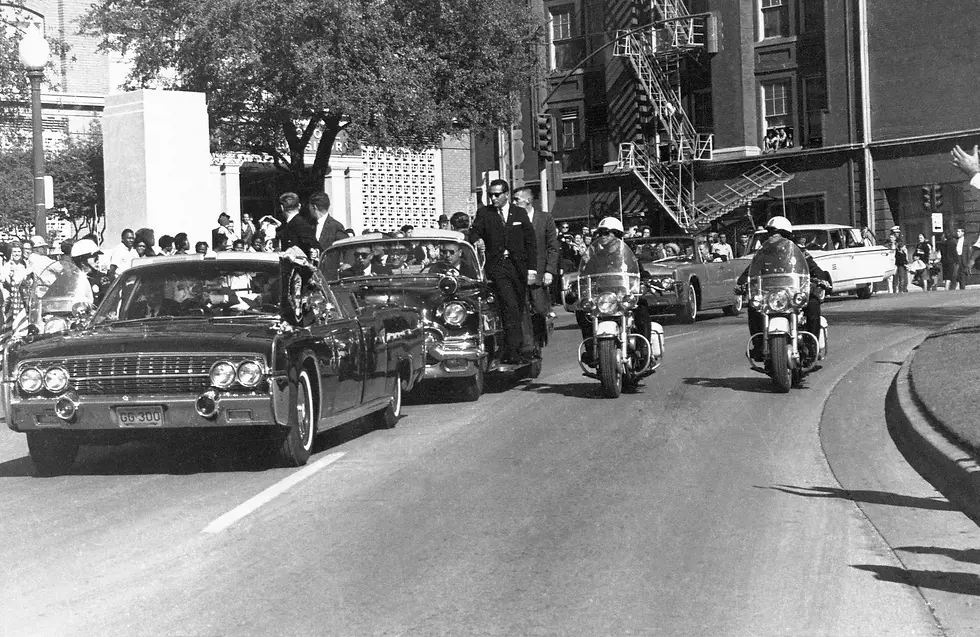
Photo from November 22nd, 1963.
WUNC News
Photo of Jack Ruby.
The U.S. Sun
Signed sketch titled ''President Kennedy's Wounds," by Dr. Robert McClelland, one of the physicians who attended to John F. Kennedy after the shooting.
NYPOST
Privacy Policy
A legal disclaimer
The explanations and information provided on this page are only general and high-level explanations and information on how to write your own document of a Privacy Policy. You should not rely on this article as legal advice or as recommendations regarding what you should actually do, because we cannot know in advance what are the specific privacy policies you wish to establish between your business and your customers and visitors. We recommend that you seek legal advice to help you understand and to assist you in the creation of your own Privacy Policy.
Privacy Policy - the basics
Having said that, a privacy policy is a statement that discloses some or all of the ways a website collects, uses, discloses, processes, and manages the data of its visitors and customers. It usually also includes a statement regarding the website’s commitment to protecting its visitors’ or customers’ privacy, and an explanation about the different mechanisms the website is implementing in order to protect privacy.
Different jurisdictions have different legal obligations of what must be included in a Privacy Policy. You are responsible to make sure you are following the relevant legislation to your activities and location.
What to include in the Privacy Policy
Generally speaking, a Privacy Policy often addresses these types of issues: the types of information the website is collecting and the manner in which it collects the data; an explanation about why is the website collecting these types of information; what are the website’s practices on sharing the information with third parties; ways in which your visitors and customers can exercise their rights according to the relevant privacy legislation; the specific practices regarding minors’ data collection; and much, much more.
To learn more about this, check out our article “Creating a Privacy Policy”.